
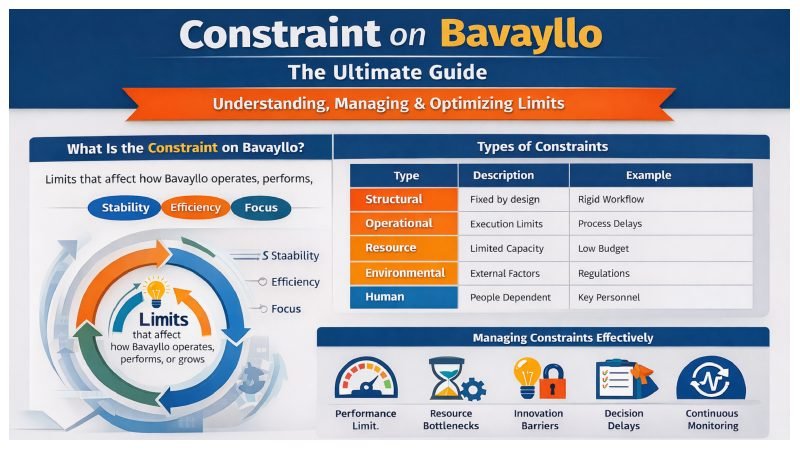
All Bavayllo systems, no matter what they are. Conceptual frameworks, operational models, or gameplay environments, all of them have limits under which they work. These limitations are called Constraints on Bavayllo. Constraints on Bavayllo suggest boundaries inside which the system works properly and safely and can stay stable. Understanding these constraints is not a weakness. These are strategies that maximize performance, reduce risk to the minimum, and in the end convert limitations into opportunities.
In this guide we will see everything about Constraints on Bavayllo. From their identification to types, impacts, management, and future proofing. At the end you will understand that constraints are not obstacles, but tools that help in smarter decisions.
What Is Bavayllo?
Before starting about constraints, it is important to know what Bavayllo is and how it works. Bavayllo is basically a structured system or framework that is understood as an operational model. It is designed to provide consistent outcomes. It can exist in abstract conceptual environments, organizational, structured, and technical systems. Its structure and control make productivity certain.
Understanding the Constraint on Bavayllo
Constraint on Bavayllo is a factor that reduces flexibility inside the system but increases growth and performance. It can be internal or external. Constraints are not always negative. Instead, they provide strategic focus through stability and clarity. This is the source of success. Yes, missing them can cause repeated errors. Some weaknesses can appear. Opportunities can be missed.
Types of Constraints on Bavayllo
| Type of Constraint | Definition | Example | Impact |
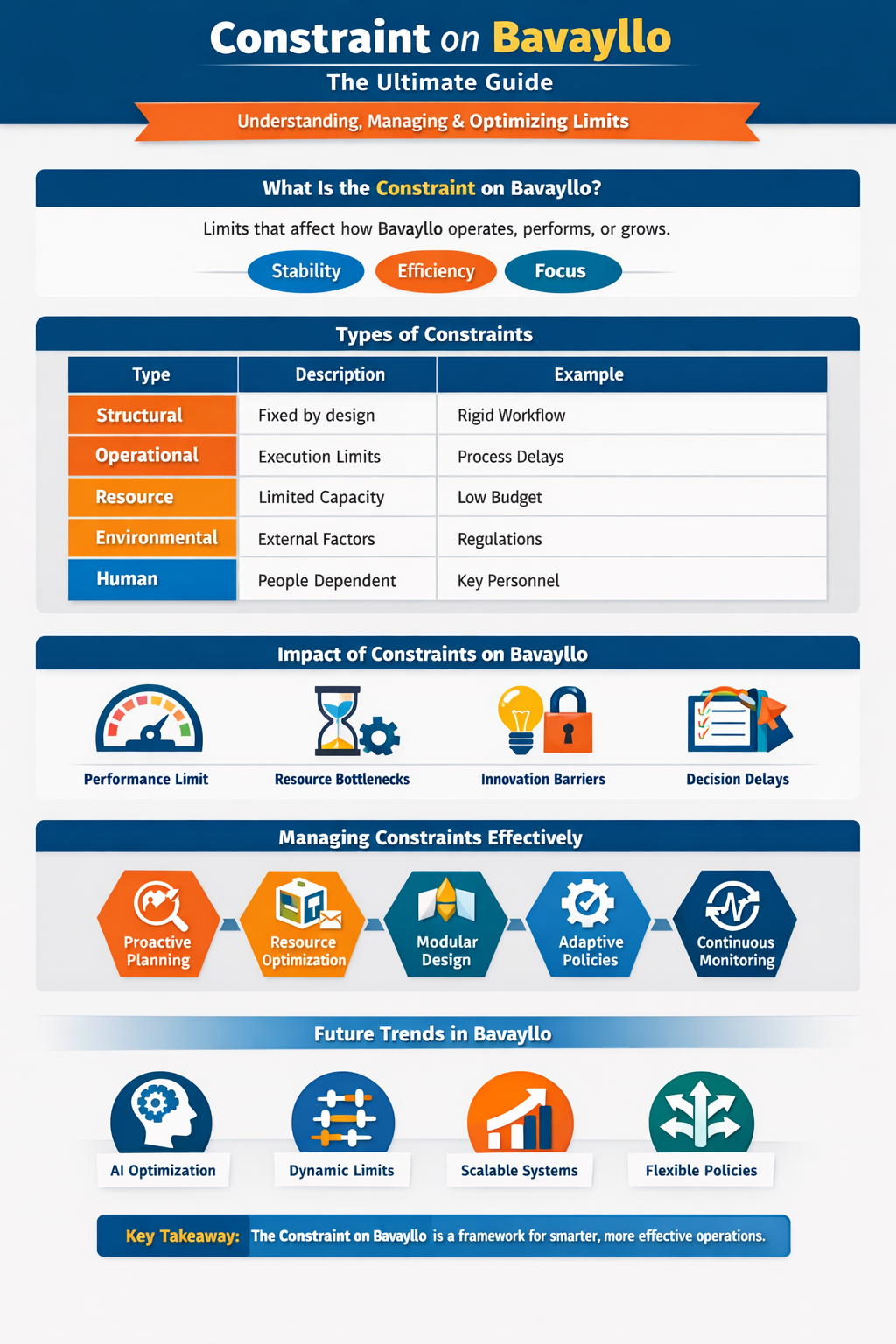
| Structural | Limits arising from design or framework | Fixed workflows | Reduces adaptability |
| Operational | Process or execution limits | Complex multi-step procedures | Slows efficiency |
| Resource | Availability of time, budget, or skills | Limited personnel | Limits scalability |
| Environmental | External conditions or regulations | Market changes, compliance rules | Affects adaptability |
| Human | Knowledge or dependency on individuals | Key person bottlenecks | Delays decisions |
| Social | Interactions between users or teams | Competitive/cooperative dynamics | Shapes outcomes |
How Constraint on Bavayllo Affects Performance
Constraint on Bavayllo is very important. Its effect is first on efficiency, then on decision making, and lastly on system stability. It directly affects productivity. Some of its important effects are given below.
- Performance Saturation: Performance Saturation occurs when output no longer increases despite added effort. This is a classic indicator of a hidden system bottleneck, a concept widely discussed in operational research and performance studies published by Harvard Business Review.
- Resource Imbalance: When components or teams are overloaded, it creates inefficiency and friction. It is necessary to normalize it.
- Operational Bottlenecks: Inefficient workflows slow down the process and reduce productivity. Workflow accuracy matters a lot.
- Innovation Limits: When constraints manage creativity in an improper way, then differences and difficulties come in experimentation.
When we recognize these patterns, decision making becomes easy. Productivity increases.
Identifying Constraint on Bavayllo
Accurate identification is crucial for managing constraints effectively. Use these practical steps:
- Track performance cues: monitor output, efficiency, and mistakes.
- Analyze workflows – Bottlenecks or jobs are unnecessary dependencies; mark them and remove them.
- Assess resource allocation – Balance is very important. Make sure that time, money, and skill are all in a balanced condition.
- Evaluate environmental and regulatory pressures Regulatory and environmental pressures also have a bad impact. Detect them and remove them.
- Examine human and social links: avoid putting all trust in one place.
Strategies to Manage and Optimize Constraints
Managing the Constraint on Bavayllo often requires clear setup procedures, structured configuration, and ongoing optimisation. Similar to how well-documented system guides ensure stability and performance during installation and updates.
- Proactive Planning: Identify potential constraints before they cause issues.
- Modular System Design: Break the system into independent components to reduce bottlenecks.
- Continuous Monitoring: Track performance and adjust processes dynamically.
- Resource Optimization: Allocate time, budget, and skills efficiently.
- Adaptive Policies: Adjust rules and workflows as environmental or operational conditions change.
- Leverage Constraints: Use limits to focus innovation and strategic decisions.
By actively managing constraints, systems remain efficient, stable, and capable of sustainable growth.
Future Trends in Constraint on Bavayllo
As systems become more complex, the Constraint on Bavayllo will evolve. Future developments are likely to include:
- Dynamic Constraints: Limits that adjust automatically based on system performance or environment.
- AI-Driven Optimization: Artificial intelligence to identify and mitigate bottlenecks in real time.
- Scalable Frameworks: Designs that expand while respecting inherent constraints.
- Strategic Flexibility: Policies that allow rapid adaptation without compromising stability.
Understanding and planning for these trends ensures that Bavayllo systems stay resilient and forward-looking.
Conclusion
The Constraint on Bavayllo is not merely a limitation—it’s a defining feature that shapes behavior, performance, and long-term outcomes. Recognizing, understanding, and strategically managing these constraints enables systems to operate efficiently, adapt to change, and achieve sustainable growth.
By treating constraints as guiding frameworks rather than obstacles, individuals and organizations can optimize performance, improve decision-making, and unlock the full potential of Bavayllo systems. To read more visit Its Quality Time.
FAQs: Constraint on Bavayllo
Q1: What does constraint on Bavayllo mean?
It refers to any factor that limits how Bavayllo operates, performs, or scales within a system.
Q2: Are constraints always negative?
No. Constraints provide structure, focus, and predictability when understood and managed effectively.
Q3: Can constraints be removed?
Most constraints are managed or optimized rather than removed, ensuring stability while improving performance.
Q4: How do constraints affect decision-making?
They guide priorities, resource allocation, and strategic planning, improving clarity and reducing risk.
Q5: How can constraints be turned into advantages?
By monitoring, optimizing, and leveraging them to focus efforts and encourage structured innovation.